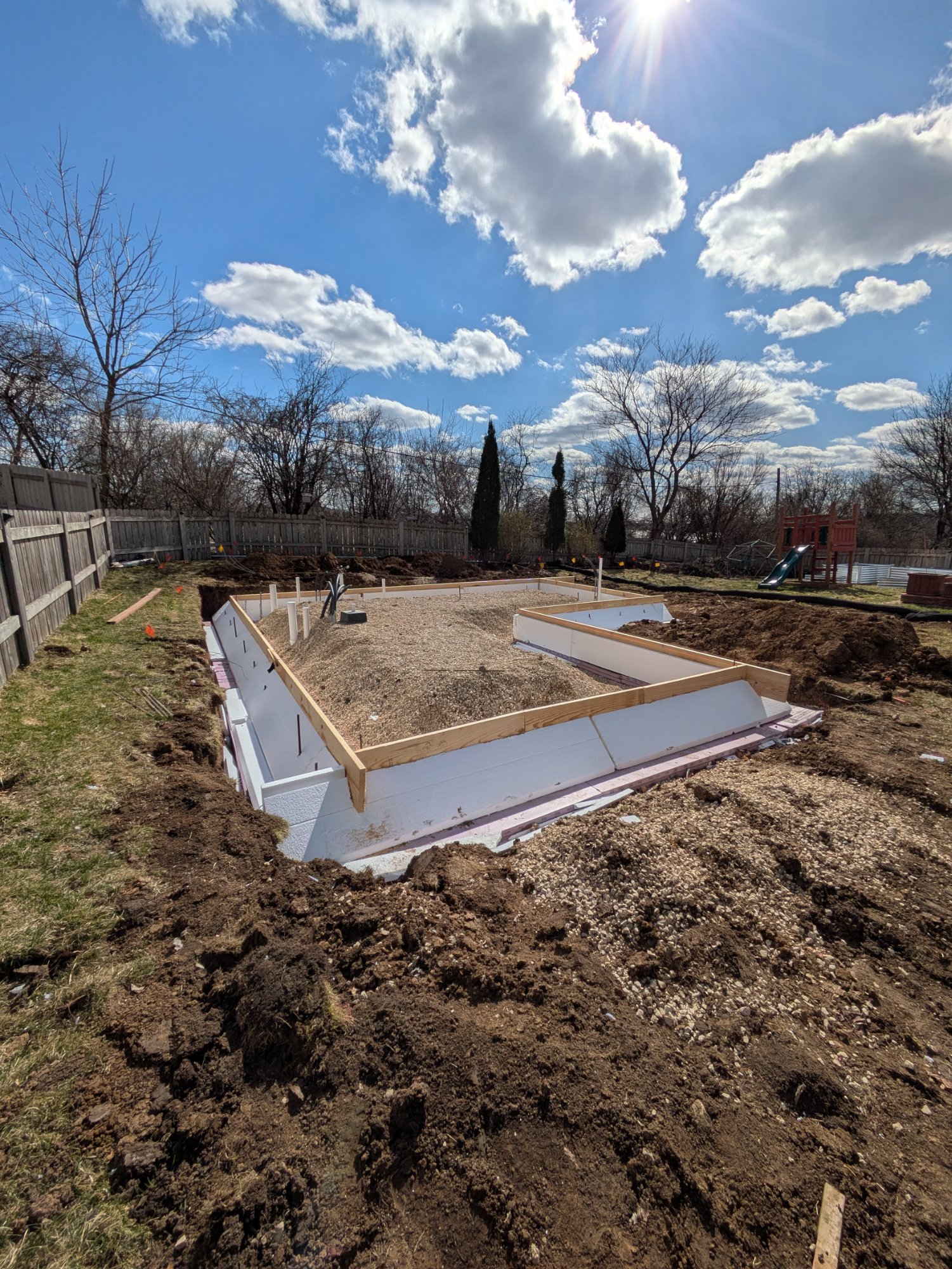
Before a single wall panel goes up, your ADU needs a foundation that works — not just for the structure, but for Wisconsin's climate. With a frost depth of roughly 48 inches in Dane County, the foundation decision carries more weight here than in most of the country. There are three main options, and the right one depends on your site, your budget, and what the ADU is meant to do.
The Frost Problem in Climate Zone 6
Wisconsin sits in Climate Zone 6. That means ground frost regularly penetrates to 48 inches or more during winter. Any foundation that doesn’t account for this will heave — the ground expands as it freezes, and if your footings are above the frost line, the structure moves with it. Cracked walls, sticking doors, and failed connections are the result. All three foundation types below solve this problem, just differently.
Traditional Frost Wall (Full Perimeter Foundation)
A frost wall — also called a stem wall — is the most conventional approach. Concrete footings are poured below the frost line, typically 48–54 inches down in Dane County, with a concrete block or poured wall rising to grade. A wood floor system or concrete slab sits on top.
Frost walls are well understood by local contractors and inspectors. They work on any soil type and provide a crawl space option if needed. The downside: they require significant excavation, concrete, and labor. For a detached ADU, this typically adds cost and timeline compared to alternatives.
Monolithic Concrete Slab
A monolithic slab pours the footing and floor as a single concrete pour. It’s faster than a frost wall and gives you a flat, durable floor surface ready for LVP or tile. On a well-drained site with stable soil, it performs well.
The catch in Wisconsin: a standard slab without insulation can lose significant heat through the ground. Energy code requires thermal breaks and insulation under and around the slab perimeter. Done correctly, it’s a strong option. Done cheaply, you’ll pay in heating bills.
Frost-Protected Shallow Foundation (FPSF)
An FPSF is the option gaining traction on ADU projects in Wisconsin, and for good reason. Instead of digging to 48 inches, an FPSF uses rigid foam insulation placed strategically around a shallow foundation — typically 12–16 inches deep — to keep the soil beneath it from freezing. The insulation traps the earth’s own heat, eliminating frost heave without deep excavation.
The IRC specifically addresses FPSFs and they’re approved in Madison and surrounding municipalities. For an ADU on a tight urban lot where excavation is difficult, or on a site with tree roots or underground utilities, FPSF can be significantly easier to execute. Build cost is typically lower than a full frost wall with comparable performance.
What Actually Drives the Decision
A few site-specific factors tend to settle the question. Poorly draining soil favors a frost wall or a well-designed slab with drainage provisions. FPSFs perform best on well-drained sites. Trees, setbacks, or existing utilities close to the build zone make deep excavation harder. FPSF or a slab minimizes the disruption footprint. If there’s any chance the ADU gets converted to a more permanent structure or needs a crawl space for mechanical access, a frost wall gives you that option.
We evaluate foundation type on every project individually. If you’re planning an ADU in Madison or Dane County and want a straight answer about what foundation makes sense on your specific lot, start with a feasibility check.