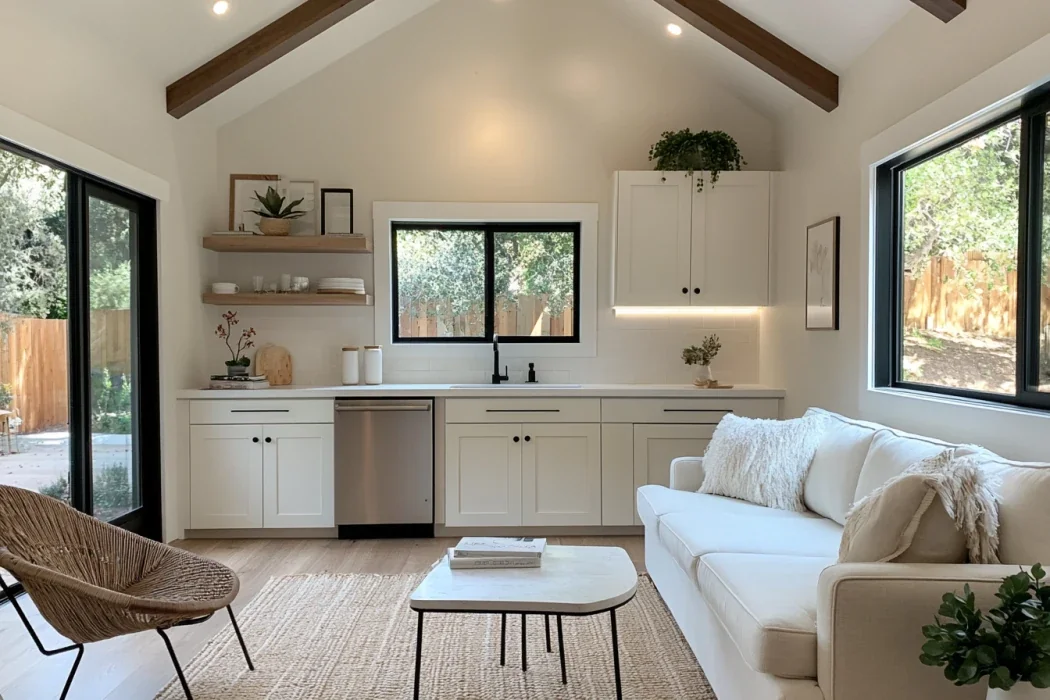
Short-term rental platforms have made a backyard ADU look like a cash machine to some homeowners. Nightly rates in Madison can run $100–$200 or more, far above what monthly rent yields on a per-night basis. But Madison regulates short-term rentals, and the rules for ADUs have specific wrinkles worth understanding before you design your build around STR income.
Madison’s Short-Term Rental Ordinance
Madison’s STR ordinance (Chapter 28 of the General Ordinances) requires a license for any short-term rental — defined as a dwelling unit rented for fewer than 29 consecutive days. Licenses must be renewed annually and the property must meet inspection requirements.
The most consequential requirement: the owner must occupy the primary residence on the property for short-term rental of an ADU to be permitted. This is Madison’s owner-occupancy requirement for STRs. If you move out of your main house and rent both structures short-term, you’re operating outside the ordinance.
License, Tax, and Insurance Requirements
Operating an STR in Madison without a license is an ordinance violation. The license requires an application and fee, proof of insurance (standard homeowner’s policies don’t cover STR activity), compliance with Dane County room tax (currently 8%), and Wisconsin sales tax. Most platforms collect taxes, but you’re responsible for confirming what’s being remitted on your behalf.
STR vs. Long-Term Rental: The Real Math
A well-located Madison ADU might command $130–$160/night on Airbnb with 60–70% occupancy — roughly $2,400–$3,400/month gross in a good month. A long-term rental in the same location likely yields $1,400–$1,600/month with zero management overhead. Subtract STR platform fees, cleaning costs, supplies, utilities, and management time. The net difference between STR and long-term rental is often smaller than the headline nightly rate suggests — especially for a single ADU where you’re not at scale.
What This Means for ADU Design
If you’re planning STR use, design accordingly: a flexible layout, a covered outdoor space, and a separate entrance that doesn’t require walking past the main house all contribute to STR performance. The structural permit requirements are identical for STR and long-term rental — same permit, same building code. The design choices diverge based on who you’re optimizing the space for.
We build ADUs in Madison and Dane County exclusively. If you’re planning for STR use and want to think through the design and location implications, start with a free feasibility check.