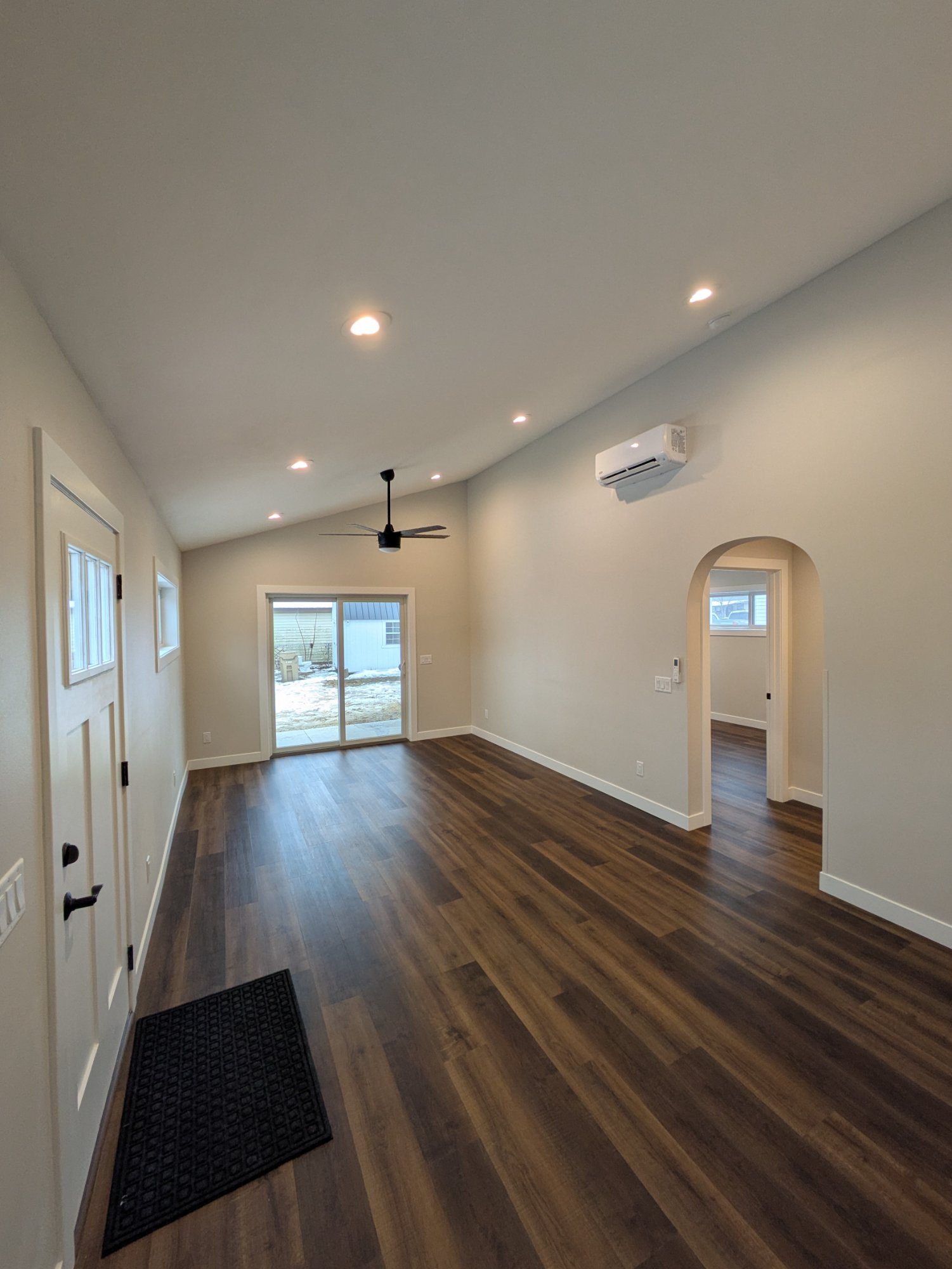
Single-story is a starting point, not a complete answer. When we design an ADU for a client whose parent will be living in it, the conversation quickly moves past “no stairs” to a set of specific decisions that determine whether the space actually functions well as mobility needs change. These decisions are far cheaper to get right at design time than to retrofit later.
Entry and Approach
The most important accessibility feature is a zero-threshold entry — no step at the front door, no threshold lip. This requires coordination: the slab or floor must be at the same elevation as the exterior hardscape, which requires site grading to slope away from the structure for drainage without a step to achieve it. A covered entry is not a luxury for an aging-in-place ADU — it’s a safety feature. A parent managing keys, a cane, or groceries in Wisconsin rain or snow needs a covered area to transition safely. Design for at least 4x6 feet of covered transition space at the primary entry.
Consider the path between the houses. A paved, level walkway from the main house to the ADU entry eliminates the most hazardous part of daily life during Wisconsin winters.
Doorway Width
Standard interior door rough openings yield about 30 inches of clear passage. A standard walker needs 32–36 inches. A wheelchair requires 36 inches. Specifying 36-inch interior doors throughout an ADU costs almost nothing at rough framing — it’s a minor lumber adjustment. Retrofitting 30-inch rough openings after drywall is a significant repair project. Build the wider doors from the start. Pay particular attention to the bathroom door, which is typically the bottleneck.
Bathroom Layout
Key bathroom elements for aging-in-place: a curbless (roll-in) shower with sloped floor rather than a threshold; grab bar blocking installed horizontally and vertically around the toilet, shower, and tub area during framing (costs $50–100, allows bars to be installed anywhere in the blocked area later without locating studs); and sufficient floor area for a wheelchair turning radius — approximately 5x5 feet of clear floor space. These are the three decisions that determine whether the bathroom is genuinely functional long-term or just nominally single-story.
Kitchen and HVAC
For kitchen accessibility: consider one counter section at 34 inches rather than standard 36 for seated use, knee clearance under sink at one section, and lever-style handles on all cabinets and faucets. For HVAC: older adults are more sensitive to temperature extremes and prefer warmer ambient temperatures. A mini-split with a large-display, simple remote control — not a smartphone-required smart thermostat — and independently controlled zone is the right system for this use case.
We’ve designed ADUs specifically for aging-in-place use in Madison and Dane County. If you’re planning one for a parent and want to talk through the specific design decisions, start with a feasibility check.