Why This Report Exists
Dane County is the fastest-growing county in Wisconsin and, increasingly, the place where the tension between housing demand and zoning policy is playing out most visibly. What Madison does — and what its suburbs do next — will shape the ADU conversation across Wisconsin for years.
This report traces Madison's thirteen-year journey of iterative zoning reform and documents how each specific change moved the permit needle. Nearly half of all ADU permits Madison has ever issued came in the twelve months after owner-occupancy requirements were removed in April 2024. That's not a coincidence — it's cause and effect, documented. Our hope is that Fitchburg, Waunakee, Mt. Horeb, and every other municipality in Dane County reads Madison's experience as a map: not a history lesson, but an active guide to which restrictions are still blocking the housing their communities say they want to build.
Homeowners evaluating whether an ADU makes sense on their property. Municipal staff and policymakers in Dane County suburbs who've adopted ADU ordinances and are now asking why adoption is near zero. Lenders, media, and builders operating in a market that's at an inflection point.
Dane County — with a focus on Madison, where the permit data is deepest and the reform timeline is long enough to show real cause and effect. The report also examines Fitchburg, Waunakee, Mt. Horeb, and other suburbs against Madison's reform arc, to show where each municipality stands relative to where Madison was when its permit activity was still near zero.
Madison has issued roughly 50 ADU permits across 13 years. That is not a demand problem. It is a friction problem — and the data now shows exactly which restrictions created the friction and what happened when they were removed.
Near half of all Madison ADU permits ever issued came after April 2024 — one reform, one year. Rents rose 47% over five years. A median-income household can no longer afford the median home. The demand for ADUs is structural. The data shows what releases it.
Seven Madison reforms since 2021. Each removed a specific barrier. Size limits, owner-occupancy rules, bedroom caps, accessory structure caps — lifted one at a time. The suburbs are at reform one. Madison shows what reforms two through seven look like.
ADUs do something no large multifamily project can: they activate existing residential land, integrate invisibly into established neighborhoods, and generate rental income at a scale homeowners can actually manage. They also serve a fast-growing senior population that increasingly needs housing options well short of a facility — independent living in Dane County now runs $8,000–$10,000 per month, before an entrance fee that can reach $500,000.
Published by Boundless Tiny Homes — Dane County's only ADU design-build firm. We publish this annually to document the market as it develops — not to sell a product, but because informed homeowners, better policy, and credible data make ADU development work for everyone. Data drawn from City of Madison Planning Division records, the 2025 Madison Housing Snapshot Report, CARPC regional planning data, Dane County Planning & Development, AARP Wisconsin, CoStar, Redfin, Zillow, and the Wisconsin Uniform Dwelling Code. See the Methodology section for full sourcing details.
The Market That Makes ADUs Necessary
Dane County's housing fundamentals — why the demand for ADUs and Tiny Homes is structural, not cyclical.
13,000 Units Behind
From 2006 to 2022, Dane County underbuilt housing by an estimated 13,000 units. That deficit doesn't self-correct. It compounds. Land costs in the Midwest are up 77% since 2015. Construction costs — materials and labor — are up 65%. Both figures more than double the rate of inflation over the same period.
New production has concentrated in large multifamily buildings that capture economies of scale. Small and mid-size buildings — 2 to 24 units, the so-called "missing middle" — represented only 9% of Madison housing built from 2015 to 2024. ADUs and backyard cottages are exactly this missing middle, built one lot at a time.
Who Bears the Cost
In 2015, a median-income two-person household could comfortably buy a typical Madison home. By 2024, that same household could afford roughly $73,000 below the median sale price — and would need nearly $100,000 just for the down payment. Homeownership for first-time buyers isn't just hard; for many it's effectively closed.
Households under 35 grew by 9,500 in Madison from 2015 to 2023. Homeowners under 35 grew by 124. That cohort — educated, income-stable, unable to buy — is the natural tenant for a well-built ADU in a walkable neighborhood.
A rental ADU at current market rates faces near-zero lease-up risk. At $1,200–$1,800/month in rent, it offsets a significant share of primary mortgage costs in one of the tightest housing markets in the Midwest.
~50 Permits. 13 Years. What It Tells Us.
Madison's ADU permitting history, in context.
Permit Volume by Period
Source: Madison Zoning Administrator Katie Bannon statements (Jan 2025); City of Madison Fall 2025 Housing Forward page.
Why the Count Is Low
Low permit volume doesn't mean low demand. It means high friction. Three specific barriers account for nearly all of Madison's suppressed ADU activity:
One documented Madison ADU near Monona Bay came in just under $300,000 — then added $25,000 in unforeseen stormwater, utility pole, and compliance costs the homeowner said they "couldn't budget for."
The project's contractor — building his first ADU — was told many decisions were made "on a case-by-case basis." This is the cost of working with a generalist in a specialist's project type.
The former requirement that an owner live on-site blocked landlords, investors, and temporarily absent homeowners. It also made ADU construction nearly unfinanceable — banks can't "occupy" a property in foreclosure.
Fitchburg issued zero ADU permits in 2025 after adopting its ordinance that September. Waunakee is two years into its ordinance with two permits. These aren't different problems — they're the same problem Madison had from 2013 to 2021: the ordinance exists, but the restrictions that block construction are still in place. Rear setbacks, lot coverage limits, owner-occupancy requirements, design matching rules — the same friction, the same near-zero result. Madison's history is the clearest predictor of what happens when those restrictions come off.
Seven Reforms in Four Years
How Madison's ADU zoning went from conditional use to one of the most permissive frameworks in Wisconsin.
Madison first permitted ADUs, but only through a public hearing process requiring commission review and discretionary approval. Lengthy. Uncertain. Few built. Max size: 700 sq ft. Owner-occupancy required.
Council converted ADUs from conditional to permitted use in single-family zones — eliminating the public hearing process. Max size raised from 700 to 900 sq ft; two-bedroom cap established. Owner-occupancy requirement remained. Limited to single-family lots.
Properties within a quarter-mile of Madison's Bus Rapid Transit routes gained expanded ADU and duplex eligibility. The first use of geography-based ADU incentives — a precursor to the citywide changes that followed.
Alder Myadze's ordinance removed owner-occupancy requirements entirely and extended ADU eligibility to lots with up to eight existing units. The 900 sq ft cap remained. Nearly half of all Madison ADU permits ever issued followed this single change. AARP Wisconsin formally supported the ordinance, arguing the owner-occupancy rule was both inequitable and incompatible with conventional financing.
Common Council passed a housing package on February 25, 2025 raising the interior size limit for attached ADUs to 1,000 sq ft, the footprint limit for detached ADUs to 1,000 sq ft, and eliminating the two-bedroom cap entirely. The Usable Open Space requirement was also removed. These rules are currently in effect.
Housing Forward package legalized two-unit buildings as permitted uses across approximately 32,000 additional Madison properties. A Backyard Lot provision enabled deep-lot subdivision — creating new buildable lots behind existing homes, distinct from (and usable alongside) ADUs.
Common Council unanimously passed the Fall 2025 Housing Forward package on October 7. Two key ADU changes: (1) a single detached ADU building may now contain two units — effectively a backyard duplex — as long as both are in one structure and no attached ADU is also present on the lot; (2) a detached ADU's footprint no longer counts toward the 1,000 sq ft cumulative limit for all accessory structures, freeing properties with existing garages to build a full-size ADU without size trade-offs. Total lot coverage requirements still apply.
Common Council created a new permitted housing type: up to eight single-family detached dwellings on a single zoning lot, with common management and/or access. Permitted in most residential districts. No projects have been developed under this ordinance yet. See Section 07.
The Signal in the Pattern
Every regulatory change since 2021 has moved in one direction. The question is not whether Madison will continue loosening ADU rules — it will. The question is whether you act while the permit volume is low and the process advantage belongs to those who already know it.
Madison's Seven Reforms Are a Playbook, Not a History
Each of the seven reforms documented above removed a specific friction point. Owner-occupancy gone — investors can now build. Size limits raised — more projects pencil out. Bedroom caps removed — families aren't size-constrained. Accessory structure cap exempted — garages don't block ADUs. Every reform had a measurable effect. The permit data makes that legible.
Fitchburg passed one ordinance and stopped. It still has the 35-foot rear setback, the 35% lot coverage cap, and design matching requirements that Madison shed over multiple rounds of reform. Waunakee's ordinance still carries restrictions Madison removed in 2021, 2023, and 2024. Mt. Horeb adopted its ordinance in March 2026 with inherited setbacks and a roof pitch cap Madison never had. None of them are at reform seven. They're at reform zero. The question isn't whether they'll need to iterate — they will. The question is how many years of near-zero permit activity it takes before the data makes that undeniable.
What ADUs Actually Cost to Build in Dane County
Wisconsin-specific cost drivers, a documented real-world project, and realistic return estimates.
The Cost Range
Site-built detached ADUs in Wisconsin run approximately $180–$400 per square foot in 2025. In Dane County, expect the upper half of that range for quality construction — typically $175,000–$350,000 all-in for a 500–1,000 sq ft unit.
The documented cost outlier in Madison: a detached ADU near Monona Bay contracted just under $300,000, then added $25,000 in unforeseen compliance costs. The total of $325,000+ reflects what happens when site-specific complications are discovered after construction begins rather than before.
Cost by Size — Rental Income Estimate
450–600 sq ft
550–700 sq ft
700–900 sq ft
900–1,000 sq ft · No bedroom cap
Estimates based on 2025 Dane County market data. Not a project budget. Confirm with a licensed contractor and current zoning rules.
Wisconsin-Specific Cost Drivers
Most ADU cost guides are written for California or Pacific Northwest climates. Wisconsin is different. These four factors consistently push Dane County ADU costs above national benchmarks:
Dane County frost depth reaches 48 inches. Full-perimeter footings or frost-protected shallow foundations are required. Foundation work is 10–15% of total project cost and must be specified before anything else is designed.
Wisconsin's Uniform Dwelling Code enforces current IECC standards for Climate Zone 6. Insulation, air sealing, and mechanical specs are materially more expensive than comparable work in warmer climates.
Heat pump performance must be specified at January design temperatures (-10°F), not rated at 47°F. Backup heat, mini-split sizing, and system commissioning add meaningful cost that warm-weather ADU guides simply don't account for.
Stormwater management plans, utility lateral conflicts, and drain/shower pan decisions that must be made before slab pour — earlier than most clients expect. Each is a cost and schedule risk for a builder encountering them for the first time.
The Senior Housing Case — and AARP Wisconsin's Role
Dane County has 86,000+ residents over 65. Most of them want to stay. ADUs are the most practical tool available.
Why AARP Wisconsin Pushed for These Changes
AARP Wisconsin formally supported Madison's April 2024 ADU ordinance changes — the ones that removed owner-occupancy requirements and expanded eligibility to multi-unit properties. Their written advocacy made two specific arguments:
Equal treatment. Madison doesn't require primary homeowners to live in their properties, so applying that rule only to ADU owners treats the accessory unit as inferior real estate. "Either require all owners to occupy their own home or none," AARP Wisconsin argued.
Financing access. Owner-occupancy requirements are fundamentally incompatible with conventional lending. When a bank forecloses, it cannot "occupy" a property. Lenders will not finance ADU construction when the owner-occupancy covenant is in place — which means the people most likely to build ADUs for aging parents are also the ones most likely to need a loan.
AARP Wisconsin's 2024 Year in Review listed "supported Accessory Dwelling Unit ordinances in La Crosse and Madison" as a key statewide accomplishment. Their community outreach representative, Darrin Wasniewski, called the April 2024 ordinance change "the epitome of where you want to go" when speaking before Madison's Common Council.
$96,000–$120,000 annually — before the entrance fee, which typically runs $50,000 to $500,000. That's enough to finance a quality ADU several times over.
2018 AARP national survey. One in three said they would consider building one. That data is from before the current housing affordability crisis.
Accessory Dwelling Units are one of the most practical, community-friendly tools we have to expand housing choice without changing the character of existing neighborhoods. AARP supports ADUs because they help older adults remain independent, support multigenerational living, and create more attainable housing options close to family, services, and transit. In Madison and communities across Wisconsin, we've worked alongside local leaders and builders to advance policies that make it easier to add these small-scale homes — because when communities offer people more ways to live and age in place, everyone benefits.Darrin Wasniewski, AARP Wisconsin
ADUs built for multigenerational or senior use should incorporate single-level layouts, no-step entries, 36" doorways, grab-bar blocking in bathrooms, and mechanical systems accessible without outdoor access. These features add modest cost at construction and significant value over the life of the unit.
Entry
Doorways
Shower
Blocking
Layout
Where You Can Build — Across Dane County
Wisconsin has no statewide ADU law. Every municipality sets its own rules. Here's where things stand across the county's major communities as of Q1 2026.
Regulations change. Verify current requirements with the relevant planning department before committing to a project.
Bedroom cap: None (eliminated Feb 2025)
Owner-occupancy: Not required (removed Apr 2024)
Eligible lots: Up to 8 existing units
Setbacks: 3 ft from structure; 3 ft from rear/side lot lines
Height max: 25 ft (detached)
Parks impact fee: ~$4,500
Process: Site plan approval required. Licensed contractors must pull permits. ADU footprint does not count toward the 1,000 sq ft accessory structure cap (exemption passed Oct 7, 2025).
Owner-occupancy: Required — owner must live on property
Stories: Single-story only; 22 ft max height
Setbacks: 3 ft side/rear; 5 ft from primary residence
Types: Detached or attached
Process: No conditional use permit required
Strong demand driven by proximity to Epic Systems and UW Health. Contact Middleton Planning for current requirements: cityofmiddleton.us
Owner-occupancy: Not required
Stories: Two-story allowed; 25 ft max height
Setbacks: Inherited from underlying zoning district — in R-LM, 30 ft front, 10 ft side, 35 ft rear
Lot coverage: 35% max — house, garage, driveway, and ADU all count; no ADU exemption
Design: Exterior materials, roof pitch, trim, eaves, and window proportions must match the primary home
Process: No CUP required for the ADU itself — but setback reductions require Plan Commission approval
Adopted: September 2025 (Ordinance 2025-O-17)
Fitchburg's ordinance technically permits ADUs in all residential districts. But the practical barriers are significant: the 35-foot rear setback — inherited from the zoning district, not tailored for ADUs — eliminates most lots without a conditional use hearing. The 35% lot coverage cap leaves no room on properties with existing garages and driveways. Prescriptive design matching eliminates cost-efficient construction methods. As of Q1 2026, zero ADU permits have been issued. Compare to Madison: 3 ft rear setback, no design matching, ADU footprint exempt from the accessory structure cap. Fitchburg's ordinance needs the same iterative refinement Madison applied over seven reforms before permits will follow.
The municipalities with the highest unrealized ADU potential aren't the ones with the best current rules. They're the ones growing fastest — Sun Prairie, Verona, Waunakee. Their ordinances are the bottleneck, not their markets. Any regulatory opening in these communities is a first-mover window.
Here in Dane County, I see a particularly strong future for ADUs. With growing communities like Madison and others continuing to explore progressive zoning policies and housing strategies, ADUs are well-positioned to become a key part of our regional housing solution. Their adaptability makes them especially suited to our neighborhoods, where incremental, well-designed growth can have a lasting positive impact. As an architect, I see ADUs as a powerful intersection of design, sustainability, and community. When done well, they are not just small homes — they are strategic solutions to some of our most pressing housing and environmental challenges.Philip Ashby, Architect — House Architect
Cottage Courts: An Empty Market, Just Opened
Ordinance 90557, passed December 2025, created a new housing type in Madison. As of Q1 2026, zero projects have been built under it.
What a Cottage Court Is
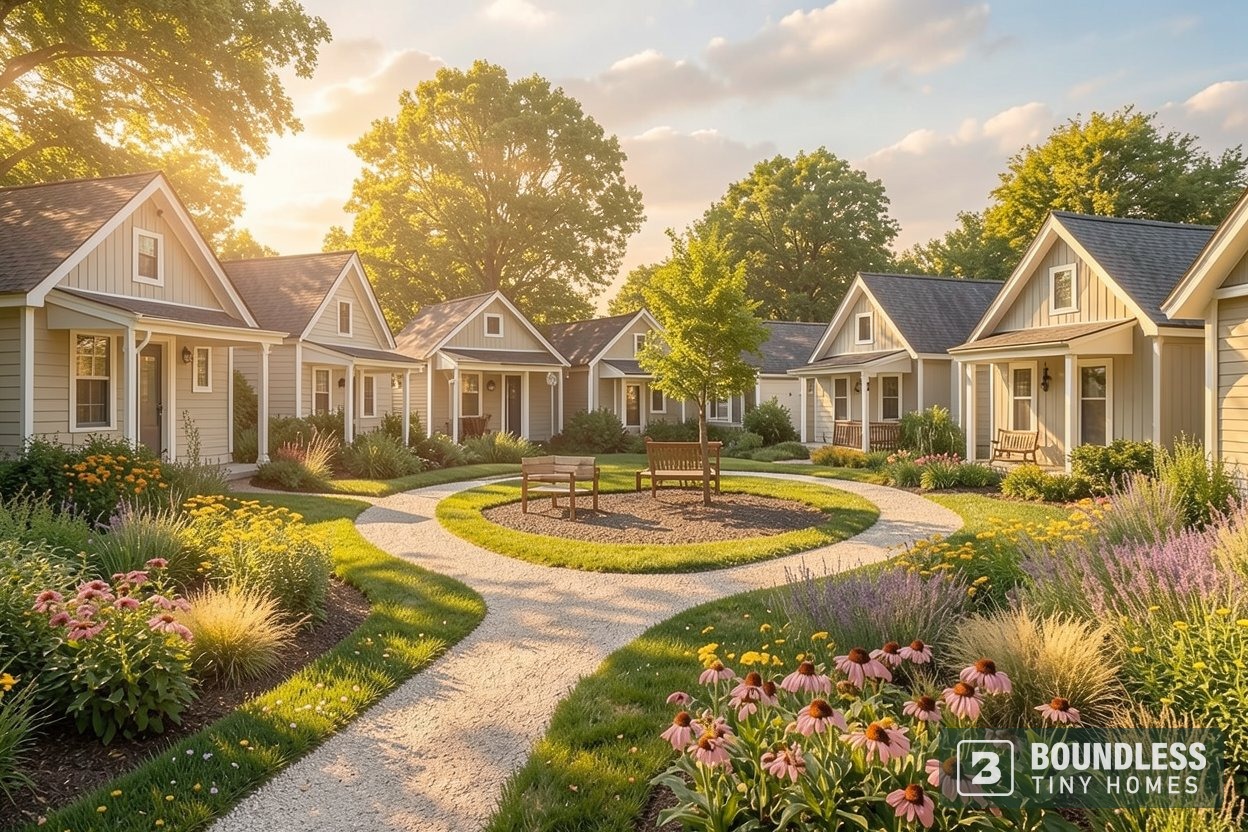
A cottage court is a cluster of up to eight small detached homes on a single zoning lot, sharing common management and/or access. The form draws from the historic "bungalow court" tradition: small houses around shared open space, compact and community-oriented without being high-density.
The ordinance passed as part of Madison's broader "missing middle" housing strategy — targeting the gap between single-family homes and large apartment buildings where neither existing builder type operates well.
The Builder Competency Gap
A cottage court requires the same capabilities as ADU construction: compact space planning, cold-climate mechanical systems, small-site coordination, and Wisconsin UDC compliance on sub-1,000 sq ft structures. These competencies are specific to small-home construction and aren't developed through large single-family or multifamily work.
One noted friction in the current ordinance: impact fees for homes under 1,000 sq ft are charged at full single-family rates rather than ADU rates — adding approximately $2,300 per unit, or nearly $20,000 on an eight-unit project. This is a recognized policy gap that future amendments may correct.
Wisconsin in National Context
The U.S. is producing 200,000+ ADU permits annually. Wisconsin produces almost none. The gap is policy, not demand.
California accounts for 32% of all ADU permits nationally — the direct result of state legislation making approvals ministerial, capping fees, and removing local barriers. Following California's 2017 reform, Los Angeles ADU permits increased 30-fold. Oregon, Washington, Vermont, Montana, and Arizona have since passed similar preemptive laws.
Wisconsin operates on the opposite model. There is no state ADU law. The Wisconsin Uniform Dwelling Code governs construction and safety standards, but zoning permission, size limits, setback rules, and approval timelines are entirely local decisions. This produces 57+ different ADU frameworks across Dane County's municipalities alone.
The implication: Wisconsin's ADU market is not suppressed by lack of demand. It is suppressed by fragmentation and process opacity. That fragmentation creates a durable moat for builders who have navigated it — and a steep learning curve for those who haven't.
ADU Permit Share by State, 2018–2024
California accounts for nearly one in three ADU permits issued nationally. States with preemptive statewide ADU legislation (CA, OR, WA) dominate the top tier. Wisconsin's share is effectively zero on this scale.
Source: Shovels.ai analysis of 2.8 million U.S. ADU permits, 2018–2024. State totals are approximate; Wisconsin share is negligible at national scale.
Shovels.ai analysis of 2.8 million ADU permits across the U.S. confirms: permit volume is driven by policy, not demand. Demand is virtually everywhere. What changes the output is whether the regulatory environment enables or suppresses it. Madison has spent four years removing suppression mechanisms.
National ADU prefab platforms based in California do not build in Wisconsin. They lack cold-climate foundation engineering, Wisconsin UDC compliance expertise, Dane County permit relationships, and licensed trade networks. Local knowledge isn't a differentiator — it's the barrier to entry.
200,000+ ADU Permits Issued Nationally in 2024
California leads with 32% of the national total. States with ministerial approval have permit rates many times higher than comparable markets without it. Wisconsin is in the early stage of that curve.
No State Law — Local Expertise Is Everything
Unlike California, Oregon, or Washington, Wisconsin cannot be entered by a platform or out-of-state company that bought a marketing channel. Every project requires local licensing, local trade relationships, and local permit knowledge.
2026 Watchlist
Six regulatory and market developments worth tracking over the next 12 months in Dane County's ADU landscape.
Two-Unit Detached ADUs — Now Permitted
The Fall 2025 Housing Forward package passed unanimously on October 7. A detached ADU building may now contain two units (a backyard duplex in one structure), and ADU footprint no longer counts against the 1,000 sq ft accessory structure cap. This is the most significant ADU income-generation change since the 2024 owner-occupancy removal — and it's already in effect.
First Cottage Court Projects
No projects have yet been built under Ordinance 90557. The first ones will be closely watched by planners, media, and neighbors. Early well-executed projects cement the format's viability. Early failures could slow future permitting.
Dane County's 139,000-Home Target
The county's 2024 Regional Growth Strategy calls for 139,000 new homes by 2040. This mandate will increasingly pressure suburban municipalities — Sun Prairie, Verona, Waunakee — to liberalize ADU rules to meet regional housing obligations.
ADU Lending Products
The removal of owner-occupancy requirements opens ADU construction to conventional investment financing. As permit volume grows, watch for specialized lending products — ADU construction loans, HELOC-to-permanent structures — from local credit unions and community banks.
Tariff Impacts on Materials
2026 tariffs on lumber, steel, and imported materials are already being cited by Wisconsin builders as cost drivers. ADU construction is particularly sensitive to material cost increases due to small project scale and limited purchasing leverage.
Backyard Lot + ADU Interaction
Madison's Summer 2025 backyard lot subdivision provision and ADU rules now coexist. Their interaction — can a subdivided lot also have an ADU? how do setbacks interact? — hasn't been tested in real projects yet. First cases will set precedent.
The Fundamentals Don't Change
Whatever the regulatory calendar produces in 2026, the underlying conditions driving ADU demand in Dane County are structural. The county has a 13,000-unit housing deficit built up over a decade. It has 86,000+ residents over 65. Its rental vacancy sits at 4.8% and falling. Its ownership market has effectively no inventory. Its homeowners hold enough equity — on average — to finance ADU construction. And its policy direction has been consistently toward liberalization for four straight years.
The market timing argument for ADUs is not "do it before it's too late." It's simpler: every year of delay is a year of rental income not collected, and a year of increasing project costs.
A Vision for ADUs in Dane County
The policy environment is improving. But homeowners still face real friction — and some of it is structural. Here's what we'd like to see change.
The Progress Is Real — and Incomplete
Madison has made more ADU regulatory progress in the last four years than in the previous decade. That's worth acknowledging. The owner-occupancy removal, the size limit increases, the eligibility expansions — these are substantive changes that moved the market.
But the volume tells the story: roughly 50 ADU permits in 13 years. A fraction of what the demand warrants. The rules have improved; the friction hasn't fully resolved. Three pain points account for most of the gap between homeowners who want ADUs and homeowners who build them.
Site plan review, agency responses, permit issuance — the current process can stretch four to eight weeks just for approval, before a shovel enters the ground. For homeowners already stretched thin, uncertainty in timelines becomes a reason to postpone or abandon projects. Streamlined by-right approvals for qualifying ADUs would unlock significant pent-up demand.
Madison's ~$4,500 Parks Impact Fee, stormwater compliance costs, and utility lateral extensions add $10,000–$30,000 to projects before construction begins. These fees are less visible than construction costs but just as real. Reduced or waived impact fees for ADUs — as several California cities have adopted — meaningfully change the economic calculus for homeowners on the margin.
A pattern is repeating across Dane County's suburbs: a municipality passes an ADU ordinance, declares the issue addressed, and moves on — without removing the specific restrictions that determine whether ADUs are actually buildable. Fitchburg adopted Ordinance 2025-O-17 in September 2025. ADUs are technically permitted in every residential district. But a 35-foot rear setback inherited from the underlying zoning district eliminates most lots. A 35% lot coverage cap leaves no room on properties with existing garages and driveways. Prescriptive design matching requirements add cost that erodes project economics. Zero permits have been issued. Waunakee adopted its ordinance in May 2024 — two years in, two permits. Mt. Horeb's new ordinance inherits rear setback requirements from the underlying zoning district rather than establishing ADU-specific standards, leaving significant rear setbacks that remove most detached ADU candidates before any other rule is applied — compounded further by a 50% roof pitch height cap with no precedent in any functioning ADU market.
Madison's trajectory makes the lesson plain: removing owner-occupancy in 2021 was necessary but not sufficient. Permit activity didn't materially accelerate until setbacks were reduced to 3 feet, size limits were raised, the ADU footprint was exempted from the accessory structure cap, and design restrictions were removed — over multiple reforms, across multiple years. The suburbs that want ADU adoption need to follow the same iterative playbook. Passing a first ordinance that leaves the hardest restrictions in place isn't progress. It's a placeholder.
For most homeowners, ADU financing comes down to two options: cash or a home equity product. Construction loans for ADUs are difficult to obtain — few lenders have underwriting experience with them, and appraisals often don't reflect the income potential of the finished unit. The practical result is that ADU construction is largely restricted to homeowners who have already built substantial equity and are willing to tap it.
Other states have addressed this directly. California's ADU financing programs, Oregon's revolving loan funds, and several municipal programs have made ADU construction accessible to a broader range of homeowners. Madison ran a small ADU loan program for a period — but it operated without the ADU-friendly zoning reforms that came later, which meant homeowners who could access the capital still faced significant regulatory friction. The financing and the policy were never aligned at the same time. Reinstating and expanding dedicated ADU financing at the city or county level would remove one of the most consistent barriers we hear from homeowners who want to build but can't access the capital to do it.
The Fragmentation Problem
The most significant structural barrier in Dane County isn't any single rule — it's the patchwork itself. With 57+ municipalities each setting their own ADU policies, a homeowner in Waunakee operates under entirely different rules than a homeowner a few miles away in Madison. Most of them don't know that until they try to build.
The data makes the threshold visible. Waunakee adopted its ADU ordinance in May 2024 and has issued exactly 2 ADU permits in the two years since. The demand exists — the school district alone drives persistent family housing pressure. But the ordinance still carries owner-occupancy requirements, a 15-foot height limit that makes ADU-above-garage construction impossible, a combined accessory structure size cap that applies to every building on the lot, and single-story constraints. Each restriction alone is manageable. Stacked together, they push the practical cost and complexity past what most homeowners will commit to. Until those restrictions come off — as they did in Madison — permit activity stays near zero. There's a threshold, and Waunakee hasn't crossed it yet.
Cities like Madison and Middleton are demonstrably leading the way — actively reforming their codes, removing restrictions, and signaling to homeowners that ADUs are welcome. The gap between these communities and the rest of the county is growing, not shrinking.
The fragmentation problem can't be solved municipality by municipality. California's 30× permit increase — Los Angeles going from hundreds of ADUs annually to tens of thousands — didn't happen because LA decided to reform. It happened because Sacramento forced the issue. A single piece of state legislation removed local barriers statewide, overnight.
Oregon, Washington, Vermont, Montana, and Arizona have all followed the same model: preemptive state ADU law that sets a permissive baseline every municipality must meet. Wisconsin has no such law. Every homeowner outside of Madison's city limits is subject to whatever rules their municipality chose to adopt — or chose not to adopt.
A Wisconsin statewide ADU law — establishing by-right permitting, reasonable size and setback standards, and a prohibition on owner-occupancy requirements — would do more for housing production across Dane County than any number of individual municipal reforms.
Statewide ADU reform in Wisconsin — the same policy lever that unlocked explosive permit growth in California, Oregon, and Washington. Locally: continued accelerating reform in Madison and its suburbs, streamlined permit timelines, reduced impact fees proportional to ADU size, simplified utility coordination, and reinstated ADU financing programs that give homeowners a path beyond cash and equity. The municipal progress is real. But the structural fix is in Madison on the Capitol Square, not Madison on the isthmus.
ADU Resources
A curated set of resources — from the City, from advocacy organizations, and from BTH — for homeowners, policymakers, and housing professionals exploring ADUs in Dane County.
The official step-by-step guides from Madison's Development Services Center — one for detached ADUs and one for attached. The most authoritative source for current requirements.
Madison's Housing Forward initiative tracks all active and proposed zoning changes — the single best place to monitor ongoing ADU policy evolution in real time.
Zoning information and planning resources for unincorporated Dane County and rural residential areas — essential for homeowners outside of municipal boundaries.
AARP Wisconsin's Madison-specific ADU resource — covering their policy positions, the housing case for older adults, and the financing barriers the organization has advocated to remove.
A free 24-page guide from AARP covering what ADUs are, how they expand housing options for people of all ages, financing basics, and design considerations. Useful baseline reading for any homeowner.
Zoning rules by municipality, step-by-step permit guides, cost breakdowns, and design information — built specifically for Dane County homeowners and updated as rules change.
This report is published by Boundless Tiny Homes, a Madison-based ADU design-build firm serving Dane County homeowners. Questions about this report or ADU projects: 608-400-0121 · boundlesstinyhomes.com